Pages

Jun 19, 2011

The Mausoleum at Halicarnassus
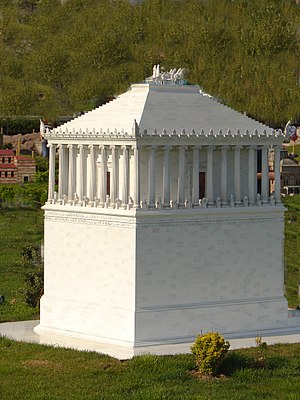

The Mausoleum at Halicarnassus
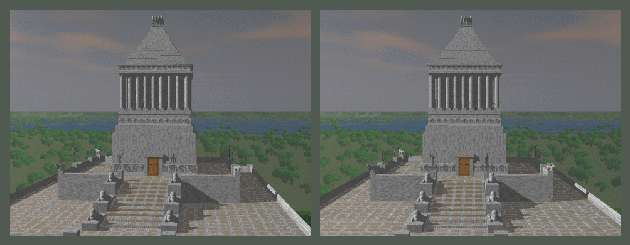
 The Mausoleum. Copyright Lee Krystek, 1998
In 377 B.C., the city of Halicarnassus was the capitol of a small kingdom along the Mediterranean coast of Asia Minor. It was in that year the ruler of this land, Hecatomnus of Mylasa, died and left control of the kingdom to his son, Mausolus. Hecatomnus, a local satrap to the Persians, had been ambitious and had taken control of several of the neighboring cities and districts. Mausolus in his time, extended the territory even further so that it finally included most of southwestern Asia Minor.
Mausolus, with his queen Artemisia, ruled over Halicarnassus and the surrounding territory for 24 years. Mausolus, though he was descended from the local people, spoke Greek and admired the Greek way of life and government. He founded many cities of Greek design along the coast and encouraged Greek democratic traditions.
Then in 353 B.C. Mausolus died, leaving his queen Artemisia, who was also his sister (It was the custom in Caria for rulers to marry their own sisters), broken-hearted. As a tribute to him, she decided to build him the most splendid tomb in the known world. It became a structure so famous that Mausolus's name is now associated with all stately tombs through our modern word mausoleum. The building was also so beautiful and unique it became one of the Seven Wonders of the Ancient World.
Artemisia decided that no expense was to be spared in the building of the tomb. She sent messengers to Greece to find the most talented artists of the time. This included Scopas, the man who had supervised the rebuilding of the Temple to Artemis at Ephesus. Other famous sculptors such as Bryaxis, Leochares and Timotheus joined him as well as hundreds of other craftsmen.
The tomb was erected on a hill overlooking the city. The whole structure sat in an enclosed courtyard. At the center of the courtyard was a stone platform on which the tomb itself sat. A staircase, flanked by stone lions, led to the top of this platform. Along the outer wall of this were many statues depicting gods and goddess. At each corner stone warriors, mounted on horseback, guarded the tomb.
At the center of the platform was the tomb itself. Made mostly of marble, the structure rose as a square, tapering block to about one-third of the Mausoleum's 140 foot height. This section was covered with relief sculpture showing action scenes from Greek myth/history. One part showed the battle of the Centaurs with the Lapiths. Another depicted Greeks in combat with the Amazons, a race of warrior women.
On top of this section of the tomb thirty-six slim columns, nine per side, rose for another third of the height. Standing in between each column was another statue. Behind the columns was a solid block that carried the weight of the tomb's massive roof.
The roof, which comprised most of the final third of the height, was in the form of a stepped pyramid. Perched on top was the tomb's penultimate work of sculpture: Four massive horses pulling a chariot in which images of Mausolus and Artemisia rode.
Soon after construction of the tomb started Artemisia found herself in a crisis. Rhodes, an island in the Aegean Sea between Greece and Asia Minor, had been conquered by Mausolus. When the Rhodians heard of his death they rebelled and sent a fleet of ships to capture the city of Halicarnassus. Knowing that the Rhodian fleet was on the way, Artemisa hid her own ships at a secret location at the east end of the city's harbor. After troops from the Rhodian fleet disembarked to attack, Artemisia's fleet made a surprise raid, captured the Rhodian fleet, and towed it out to sea.
Artemisa put her own soldiers on the invading ships and sailed them back to Rhodes. Fooled into thinking that the returning ships were their own victorious navy, the Rhodians failed to put up a defense and the city was easily captured quelling the rebellion.
Artemisa lived for only two years after the death of her husband. Both would be buried in the yet unfinished tomb. According to the historian Pliny, the craftsmen decided to stay and finish the work after their patron died "considering that it was at once a memorial of their own fame and of the sculptor's art."
The Mausoleum overlooked the city of Halicarnassus for many centuries. It was untouched when the city fell to Alexander the Great in 334 B.C. and still undamaged after attacks by pirates in 62 and 58 B.C.. It stood above the city ruins for some 17 centuries. Then a series of earthquakes shattered the columns and sent the stone chariot crashing to the ground. By 1404 A.D. only the very base of the Mausoleum was still recognizable.
Crusaders, who had occupied the city from the thirteen century onward, recycled the broken stone into their own buildings. In 1522 rumors of a Turkish invasion caused Crusaders to strengthen the castle at Halicarnassus (which was by then known as Bodrum) and much of the remaining portions of the tomb was broken up and used within the castle walls. Indeed sections of polished marble from the tomb can still be seen there today.
At this time a party of knights entered the base of the monument and discovered the room containing a great coffin. The party, deciding it was too late to open it that day, returned the next morning to find the tomb, and any treasure it may have contained, plundered. The bodies of Mausolus and Artemisia were missing too. The Knights claimed that Moslem villagers were responsible for the theft, but it is more likely that some of the Crusaders themselves plundered the graves.
Before grounding much of the remaining sculpture of the Mausoleum into lime for plaster the Knights removed several of the best works and mounted them in the Bodrum castle. There they stayed for three centuries. At that time the British ambassador obtained several of the statutes from the castle, which now reside in the British Museum.
In 1846 the Museum sent the archaeologist Charles Thomas Newton to search for more remains of the Mausoleum. He had a difficult job. He didn't know the exact location of the tomb and the cost of buying up all the small parcels of land in the area to look for it would have been astronomical. Instead Newton studied the accounts of ancient writers like Pliny to obtain the approximate size and location of the memorial, then bought a plot of land in the most likely location. Digging down, Newton explored the surrounding area through tunnels he dug under the surrounding plots. He was able to locate some walls, a staircase, and finally three of the corners of the foundation. With this knowledge, Newton was able to figure out which plots of land he needed to buy.
Newton then excavated the site and found sections of the reliefs that decorated the wall of the building and portions of the stepped roof. Also a broken stone chariot wheel, some seven feet in diameter, from the sculpture on the roof was discovered. Finally, he found the statues of Mausolus and Artemisia that had stood at the pinnacle of the building.
Today these works of art stand in the Mausoleum Room at the British Museum. There the images of Mausolus and his queen forever watch over the few broken remains of the beautiful tomb she built for him.

The Colossus of Rhodes


The colossus of Rhodes, as it was - incorrectly - imagined standing at the entrance or Mandraki harbour.

The Colossus of Rhodes

In 305 BC Antigonus the One-Eyed, a powerful ruler of Macedonia and one of Alexander the Great's most successful generals, called upon the island of Rhodes to join him in a war against his rival, King Ptolemy I of Egypt. The Rhodians, however, could ill afford to go to war with Egypt, their largest trading partner, and so they refused Antigonus's offer.
To express his displeasure with this decision, Antigonus sent his son Demetrius Poliorcetes ("The Besieger") to attack Rhodes with an army of 40,000 soldiers. Demetrius was skilled in directing catapults and battering rams to crush city walls, and upon landing on the island he immediately began his efforts to break down its fortifications and defenses.
Colossus of RhodesDemetrius's tortoise-like armored battering rams were 180 feet long and manned by one thousand men, and his giant catapults threw 180-pound stone balls a quarter of a mile. Probably his most fearsome device was an enormous wheeled fortified tower called Helepolis (the "Taker of Cities"). This tower was 50 feet square at its base, more than 100 feet tall, and was armed with its own banks of catapults and sling throwers. The outlook for the island of Rhodes was grim.
"At Rhodes was set up a Colossus of seventy cubits high, representing the Sun...the artist expended as much bronze on it as seemed likely to create a dearth in the mines, for the casting of the statue was an operation in which the bronze industry of the whole world was concerned."
— Philo of Byzantium, scientist and engineer, 1st century BC

Rhodes Fights Back

Surprisingly, the people of Rhodes put up a daring resistance, and with some help from King Ptolemy their cities withstood the assault. When several of Demetrius 's siege towers were destroyed—mired down in mud created by the Rhodians, who flooded the enemy encampment—Antigonus realized that his son's forces could no longer prevail, and ordered Demetrius to make terms and abandon the island.
Demetrius reluctantly moved on to other conquests, but he left behind many of his expensive siege engines as a gift, reputedly because he was impressed with the spirit of the Rhodian's resistance (even their slaves had manned the city walls).
The Rhodians immediately set about erecting a suitable monument to their victory. They had been praying to their patron god Helios for deliverance throughout the ordeal, so they dismantled the abandoned siege engines, sold the wood and metal as scrap, and used the resulting money to pay for an enormous statue—the Colossus of Helios at Rhodes.
The Colossus took twelve years to complete, and was said to have caused a shortage of bronze throughout the ancient world during its construction. It stood about 110 feet from head to toe—about 2/3 the size of the Statue of Liberty—and consisted of a bronze outer skin supported by an internal frame of stone columns and iron bars. The burning rays of the Sun-god Helios were cast in bronze emanating from its head. Placed upon a 50-foot marble pedestal, the statue's great size ensured that it was visible to ships approaching Rhodes from many miles away. It must have seemed an indestructible monument to the growing power and prestige of Rhodes.
Colossus of Rhodes
Another Conception of the Colossus

Fate of the Colossus

As fate would have it, however, an untimely end was destined for the Colossus. In 224 BC, only sixty-five years after its completion, the statue was toppled by a strong earthquake, crushing many housesas it fell. King Ptolemy III immediately offered to pay for it to be rebuilt, but the Rhodians had been warned by an oracle to let it lie and so declined his generous offer.
The statue lay where it fell for over 875 years until Arab invaders pillaged its remains and sent the scrap metal to Syria, where it was carried off on the backs of 900 camels to be melted down—probably into bronze lamps. Nothing of the Colossus remains today, and the site upon which it once stood has not been securely identified.
The fallen ruins of the Colossus inspired as much awe as had the standing monument. A Greek named Strabo, who wrote one of the first books on geography, wrote of its ruins: "The finest of all the votive gifts and statues in the city of Rhodes is the Colossus of Helios. Now it lies on the ground, overthrown by an earthquake, severed at the knees."
In Roman times the fallen Colossus was a popular tourist attraction; Pliny the Elder visited it and wrote that "...even lying on the ground it is a marvel. Few people can make their arms meet round its thumbs, and its fingers are larger than most statues." In the Middle Ages—several centuries after the remains of the statue had been scrapped—all sorts of exaggerated tales were circulated about the Colossus. Among other things it was said to have been 900 feet tall and to bestride the harbor of Rhodes so that ships could pass beneath its legs...

The Lighthouse of Alexandria


The Lighthouse of Alexandria


The Lighthouse of Alexandria is one of the Seven Wonders of the Ancient World. It is the most recent Wonder to be built, having been built during the reign of Ptolemy I of Egypt, a commander under Alexander the Great who took over control of Egypt after Alexander's death. Historical records indicate that the Lighthouse was commissioned in 290 B.C. and completed some 2 decades later.
The Lighthouse of Alexandria is also the most well-recorded of the six destroyed members of the Seven Wonders of The Ancient World (the Pyramids of Giza being the only Wonder still standing), since it was still in operation until a serious of earthquakes demolished the structure over a few decades in the early 14th century.
Since it survived until so recently, the writings of many of the travelers who visited the Lighthouse of Alexandria also survived till this day, vividly describing what the Lighthouse looked like and what it was used for.
The Lighthouse of Alexandria was built on the island of Pharos just off the coast of Alexandria, Egypt. As such, it was also commonly known as the Pharos Lighthouse. The Pharos Lighthousewas designed by the famed architect Sostratus, and was so complicated that it took 2 decades to be completed. The best description came from the writings of Arab traveler Abou-Haggag Al-Andaloussi when he visited the Pharos Lighthouse in 1166.
Artist's Depiction of The Pharos Lighthouse of AlexandriaThe writings indicated that the structure consisted of4 main sections. At the bottom was a platform filled with statues that are still being discovered by present-day divers off the coast of Alexandria. Some researchers believe that ships docked just off this platform as well.
On top of this platform stood a square structure measuring 18 m (60 ft) on each side and roughly 56 m (184 ft) tall. In the middle of this section is a shaft and stairwell used for transporting material and fuel up the Pharos Lighthouse, and for visitors as well.
The third section was an eight-sided structure measuring roughly 27 m (90 ft) high. It also contained a similar transportation shaft in the middle. On top of this was a circular tower that housed the fire (for use to alert ships during the night) and the great mirror (for use during the day). A statue of Poseidon stood on top this tower.
The Pharos Lighthouse was a true wonder in architecture and engineering, bearing similarities to modern skyscrapers. It measured up to a modern 40-story building. The Greeks were so impressed with it that they included it as one of the Seven Wonders of the Ancient World.
The mirror of the Pharos Lighthouse appeared to be quite famous in ancient times. Many people believed that the mirror was so smooth and powerful that it could be used to reflect the sun's rays onto invading ships and burn them.
Another belief was that the mirror was so strong it could be used to observe and spy on competing city-states across the Mediterranean Sea, more than 100 miles away. However, it is highly unlikely that either of these stories are true.
A fort at AlexandriaFrom historical evidence, it appears that the Pharos Lighthouse was also a tourist attraction. Hundreds of visitors climbed the Lighthouse everyday to enjoy the fantastic view around Alexandria. Food vendors also sold their goods at the top of each section of the Pharos.
However, the Pharos Lighthouse was damaged by earthquakes, becoming totally demolished in the early 14th century. Its ruins and location were subsequently used by the Egyptian Sultan Qaitbay to build a fort in 1480, thus ending the story for this Wonder of the World.

The Temple of Artemis


File:Miniaturk 009.jpg
File:Temple of Artemis.jpg
The Temple of Artemis


  The first shrine to the Goddess Artemis was probably built around 800 B.C. on a marshy strip near the river at Ephesus ,The Ephesus Goddess Artemis, sometimes called Diana, is not the same figure as the Artemis worshipped in Greece,The Greek Artemis is the goddess of the hunt, The Ephesus Artemis was a goddess of fertility and was often pictured as draped with eggs, or multiple breasts, symbols of fertility, from her waist to her shoulders.

The shrine was destroyed and rebuilt several times over the next few hundred years. By 600 B.C., the city ofEphesus had become a major port of trade and an architect named Chersiphron was engaged to build a new large temple. He designed it with high stone columns. Concerned that carts carrying the columns might get marred in the swampy ground around the site, Chersiphron laid the columns on their sides and had them rolled to where they would be erected. This temple didn't last long. In 550 B.C. King Croesus of Lydia conquered Ephesusand the other Greek cities of Asia Minor. During the fighting, the temple was destroyed. Croesus proved himself a gracious winner, though, by contributing generously to the building of a new temple. This was next to the last of the great temples to Artemis in Ephesus and it dwarfed those that had come before.

The architect is thought to be a man named TheodorusTheodorus's temple was 300 feet in length and 150 feet wide with an area four times the size of the temple before it. More than one hundred stone columns supported a massive roof. The new temple was the pride of Ephesus until 356 B.C. when a tragedy, by name ofHerostratus, struck.

Herostratus was a young Ephesian who would stop at no cost to have his name go down in history. He managed this by burning the temple to the ground. The citizens of Ephesus were so appalled at this act they issued a decree that anyone who spoke of Herostratus would be put to death. Shortly after this horrible deed, a new temple was commissioned. 

The architect was Scopas of Paros, one of the most famous sculptors of his day. Ephesus was one of the greatest cities in Asia Minor at this point and no expense was spared in the construction. According to Piny the Elder, a Roman historian, the temple was a "wonderful monument of Grecian magnificence, and one that merits our genuine admiration." The temple was built in the same marshy place as before. To prepare the ground, Pinyrecorded that "layers of trodden charcoal were placed beneath, with fleeces covered with wool upon the top of them."


The building is thought to be the first completely constructed with marble and one of its must unusual features were 36 columns whose lower portions were carved with figures in high-relief (above). 

The temple also housed many works of art including four bronze statues of Amazon women. Piny recorded the length of this new temple at 425 feet and the width at 225 feet. Some 127 columns, 60 feet in height, supported the roof. In comparison the Parthenon, the remains of which stand on the acropolis in Athens today, was only 230 feet long, 100 feet wide and had 58 columns. According to Piny, construction took 120 years, though some experts suspect it may have only taken half that time.
  
We do know that when Alexander the Great came to Ephesus in 333 B.C., the temple was still under construction. He offered to finance the completion of the temple if the city would credit him as the builder. The city fathers didn't want Alexander's name carved on the temple, but didn't want to tell him that. They finally gave the tactful response: "It is not fitting that one god should build a temple for another god" and Alexander didn't press the matter .

Piny reported that earthen ramps were employed to get the heavy stone beams perched on top of the columns. This method seemed to work well until one of the largest beams was put into position above the door. It went down crookedly and the architect could find no way to get it to lie flat. He was beside himself with worry about this until he had a dream one night in which the Goddess herself appeared to him saying that he should not be concerned. She herself had moved the stone in the proper position. The next morning the architect found that the dream was true. During the night the beam had settled into its proper place. 

The city continued to prosper over the next few hundred years and was the destination for many pilgrims coming to view the temple. A souvenir business in miniature Artemis idols, perhaps similar to a statue of her in the temple, grew up around the shrine. It was one of these business proprietors, a man named Demetrius, that gaveSt. Paul a difficult time when he visited the city in 57 A.D.
St. Paul came to the city to win converts to the then new religion of Christianity. He was so successful thatDemetrius feared the people would turn away from Artemis and he would lose his livelihood. He called others of his trade together with him and gave a rousing speech ending with "Great is Artemis of the Ephesians!" They then seized two of Paul's companions and a near riot followed. Eventually the city was quieted, the men released, and Paul left for Macedonia. It was Paul's Christianity that won out in the end, though. 

By the time the great Temple of Artemis was destroyed during a raid by the Goths in 262 A.D., both the city and the religion of Artemis were in decline. When the Roman Emperor Constantine rebuilt much of Ephesus a century later, he declined to restore the temple. He had become a Christian and had little interest in pagan temples.

Despite Constantine's efforts, Ephesus declined in its importance as a crossroads of trade. The bay where ships docked disappeared as silt from the river filled it. In the end what was left of the city was miles from the sea, and many of the inhabitants left swampy lowland to live in the surrounding hills. Those that remained used the ruins of the temple as a source of building materials. Many of the fine sculptures were pounded into powder to make lime for wall plaster. 

In 1863 the British Museum sent John Turtle Wood, an architect, to search for the temple. Wood met with many obstacles. The region was infested with bandits. Workers were hard to find. His budget was too small. Perhaps the biggest difficulty was that he had no idea where the temple was located. He searched for the temple for six years. Each year the British Museum threatened to cut off his funding unless he found something significant, and each year he convinced them to fund him for just one more season.

Wood kept returning to the site each year many despite hardships. During his first season he was thrown from a horse, breaking his collar bone. Two years later he was stabbed within an inch of his heart during an assassination attempt upon the British Consul in Smyrna. 

Finally in 1869, at the bottom of a muddy twenty-foot deep test pit, his crew struck the base of the great temple. Wood then excavated the whole foundation removing 132,000 cubic yards of the swamp to leave a hole some 300 feet wide and 500 feet long. The remains of some of the sculptured portions were found and shipped the to British Museum where they can be viewed even today.

In 1904 another British Museum expedition under the leadership of D.G. Hograth continued the excavation. Hograth found evidence of five temples on the site, each constructed on top of the other. 

Today the site of the temple is a marshy field. A single column is erect to remind visitors that once there stood in that place one of the wonders of the ancient world. 

The Statue of Zeus at Olympia


The Statue of Zeus at Olympia

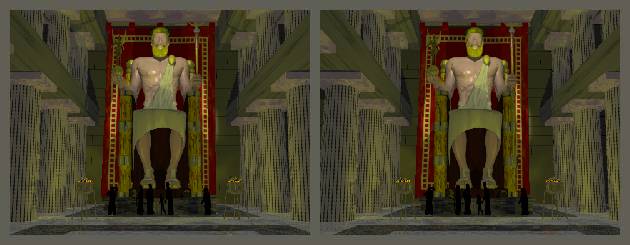
The statue of Zeus in the temple at Olympia stood more than 40 feet high  (Copyright Lee Krystek, 2011)
In ancient times one of the Greeks most mportant festivals, the Olympic Games, was held every four years in honor of the King of their gods, Zeus. Like our modern Olympics, athletes traveled from distant lands, including Asia Minor, Syria, Egypt and Sicily, to compete. The Olympics were first started in 776 B.C. and held at a shrine to Zeus located on the western coast of Greece in a region called Peloponnesus. The games helped to unify the Greek city-states and a sacred truce was declared. Safe passage was given to all traveling to the site, called Olympia, for the season of the games.


The Temple at Olympia
The site consisted of a stadium - where the competitions were actually done - and a sacred grove, or Altis, where a number of temples were located. The shrine to Zeus here was simple in the early years, but as time went by and the games increased in importance, it became obvious that a new, larger temple, one worthy of the King of the gods, was needed. Between 470 and 460 B.C., construction on a new temple was started. The designer was Libon of Elis and his masterpiece, The Temple of Zeus, was completed in 456 B.C..
Seven Quick Facts
Location: Peloponnesus (Modern Greece)
Built: Around 432 BC
Function: Shine to Greek God Zeus
Destroyed: Fire 5th Century A.D.
Size: Height around 40 ft. (12m)
Made of: Ivory and gold-plated plates on wooden frame.
Other: Remains of the workshop where it was built was found during an excavation in the 1950's
This temple followed a design used on many large Grecian temples. It was similar to the Parthenon in Athens and the Temple of Artemis in Ephesus. The temple was built on a raised, rectangular platform. Thirteen large columns supported the roof along the sides and six supported it on each end. A gently-peaked roof topped the building. The triangles, or "pediments," created by the sloped roof at the ends of the building were filled with sculpture. Under the pediments, just above the columns, was more sculpture depicting the twelve labors of Heracles, six on each end of the temple.
Though the temple was considered one of the best examples of the Doric design because of its style and the quality of the workmanship, it was decided the temple alone was too simple to be worthy of the King of the gods. To remedy this, a statue was commissioned for the interior. It would be a magnificent statue of Zeus that would become one of the Seven Wonders of the Ancient World.


Another artist interpretation of the Statue of Zeus.  (Copyright Lee Krystek, 1998)
A Statue Worthy of the King of the Gods

The sculptor chosen for this great task was a man named Phidias. He had already rendered a forty-foot high statue of the goddess Athena for the Parthenon in Athens and had also done much of the sculpture on the exterior of that temple. After his work in Athens was done, Phidias traveled to Olympia around 432 B.C. to start on what was to be considered his best work, the statue of Zeus. On arriving he set up a workshop to the west of the temple. He would take the next 12 years to complete the project.
According to accounts, the statue when finished was located at the western end of the temple. It was 22 feet wide and more than 40 feet tall. The figure of Zeus was seated on an elaborate throne. His head nearly grazed the roof. The historian Strabo wrote, "...although the temple itself is very large, the sculptor is criticized for not having appreciated the correct proportions. He has depicted Zeus seated, but with the head almost touching the ceiling, so that we have the impression that if Zeus moved to stand up he would unroof the temple..."

The Lincoln Memorial with its single large statue and columns probably is very much like the temple of Zeus except the statue of the King of the Gods was more than double the height of Lincoln.
Others who viewed that temple disagreed with Strabo and found the proportions very effective in conveying the god's size and power. By filling nearly all the available space, the statue was made to seem even larger than it really was.
Philo of Byzantium, who wrote about all of the wonders, was certainly impressed. "Whereas we just wonder at the other six wonders, we kneel in front of this one in reverence, because the execution of the skill is as incredible as the image of Zeus is holy…"
In 97 A.D. another visitor Dio Crysostomos declared the image was so powerful that, "If a man, with a heavy heart from grief and sorrow in life, will stand in front of the statue, he will forget all these."
In his right hand the statue held the figure of Nike (the goddess of victory) and in its left was a scepter "inlaid with every kind of metal..." which was topped with an eagle. Perhaps even more impressive than the statue itself was the throne made out of gold, ebony, ivory and inlaid with precious stones. Carved into the chair were figures of Greek gods and mystical animals, including the half man/half lion sphinx.

Construction of the Statue

An engraving made by Philippe Galle in 1572 was his interpretation of the statue and its associated temple.
The figure's skin was composed of ivory and the beard, hair and robe of gold. Construction was by a technique known as chryselephantine where gold-plated bronze and ivory sections were attached to a wooden frame. Because the weather in Olympia was so damp, the statue required care so that the humidity would not crack the ivory. It is said that for centuries the decedents of Phidias held the responsibility for this maintenance. To keep it in good shape the statue was constantly treated with olive oil kept in a special reservoir in the floor of the temple that also served as a reflecting pool. Light reflected off the pool from the doorway may also have had the effect of illuminating the statue.
The Greek traveler Pausanias recorded that when the statue was finally completed, Pheidias asked Zeus for a sign that the work was to his liking. The god replied by touching the temple with a thunderbolt that did no damage. According to the account a bronze hydria (water vessel) was placed at the spot where the thunderbolt hit the structure.
Besides the statue, there was little inside the temple. The Greeks preferred the interior of their shrines to be simple. The feeling it gave was probably very much like the Lincoln Memorial or Jefferson Memorial with their lofty marble columns and single, large statues. However with a height greater than 40 feet, the statue of Zesus was more than twice as tall as Lincoln's likeness at his memorial on the mall in Washington D.C..
Copies of the statue were made, but none survive, though pictures found on coins give researchers clues about its appearance.

A 1908 artist's conception of the temple at Olympia in Greece.
Despite his magnificent work at Olympia, Phidias ran into trouble when he returned home. He was a close friend with Pericles, who ruled the Athens. Enemies of Pericles, unable to strike at the ruler directly, attacked his friends instead. Phidias was accused of stealing gold meant for the statue of Athena. When that charge failed to stick, they claimed he had carved his image, and that of Pericles into the sculpture found on the Parthenon. This would have been improper in the Greeks' eyes and Phidias was thrown into jail where he died awaiting trial.
His masterpiece lived on, however. It was damaged in an earthquake in 170 B.C. and repaired. However, much of its grandeur was probably lost after Emperor Constantine decreed that gold be stripped from all pagan shrines after he converted to Christianity in the early fourth century A.D.. Then in 392 A.D. the Olympics were abolished by Emperor Theodosius I of Rome, a Christian who saw the games as a pagan rite. After that according to the Byzantine historian Georgios Kedrenos, the statue was moved by a wealthy Greek named Lausus to the city of Constantinople where it became part of his private collection of classical art. It is believed that the remains of the statue were destroyed by a fire that swept the city in 475 A.D.. However, other sources say the statue was still at the Olympic Temple when it burned down in 425 A.D..

Modern Excavations
The first archaeological work on the Olympia site was done by a group of French scientists in 1829. They were able to locate the outlines of the temple and found fragments of the sculpture showing the labors of Heracles. These pieces were shipped to Paris where they are still on display today at the Louvre.
The next expedition came from Germany in 1875 worked at Olympia for five summers. Over that period they were able to map out most of the buildings there, discovered more fragments of the temple's sculpture, and located the remains of the pool in the floor that contained the oil for the statue.
In the 1950's an excavation uncovered the workshop of Phidias which was discovered beneath an early Christian Church. Archaeologists found sculptor's tools, a pit for casting bronze, clay molds, modeling plaster and even a portion of one of the elephant's tusks which had supplied the ivory for the statue. Many of the clay molds, which had been used to shape the gold plates, bore serial numbers which must have been used to show the place of the plates in the design.

A 19th century expedition poses on the jumbled ruins of the Temple of Zeus.
Today the stadium at the site has been restored. Little is left of the temple, though, except a few jumbled columns on the ground. Of the statue, which was perhaps the most wonderful work at Olympia, all is now completely gone.

The Hanging Gardens Of Babylon


The ancient city of Babylon, under King Nebuchadnezzar II, must have been a wonder to the traveller's eyes. "In addition to its size," wrote Herodotus, a historian in 450 BC, "Babylon surpasses in splendour any city in the known world." Herodotus claimed the outer walls were 56 miles in length, 80 feet thick and 320 feet high. Wide enough, he said, to allow a four-horse chariot to turn. The inner walls were "not so thick as the first, but hardly less strong."
  
Inside the walls were fortresses and temples containing immense statues of solid gold. Rising above the city was the famous Tower of Babel, a temple to the god Marduk, that seemed to reach to the heavens. While archaeological examination has disputed some of Herodotus's claims (the outer walls seem to be only 10 miles long and not nearly as high) his narrative does give us a sense of how awesome the features of the city appeared to those that visited it. Interestingly enough, though, one of the city's most spectacular sites is not even mentioned by Herodotus: The Hanging Gardens of Babylon, one of the Seven Wonders of the Ancient World

Accounts indicate that the garden was built by King Nebuchadnezzar, who ruled the city for 43 years starting in 605 BC (There is a less-reliable, alternative story that the gardens were built by the Assyrian Queen Semiramis during her five year reign starting in 810 BC). This was the height of the city's power and influence and King Nebuchadnezzarconstructed an astonishing array of temples, streets, palaces and walls. 
According to accounts, the gardens were built to cheer up Nebuchadnezzar's homesick wife, Amyitis. Amyitis, daughter of the king of the Medes, was married to Nebuchadnezzar to create an alliance between the nations. The land she came from, though, was green, rugged and mountainous, and she found the flat, sun-baked terrain of Mesopotamia depressing. The king decided to recreate her homeland by building an artificial mountain with rooftop gardens.

The Hanging Gardens probably did not really "hang" in the sense of being suspended from cables or ropes. The name comes from an inexact translation of the Greek word kremastos or the Latin word pensilis, which mean not just "hanging", but "overhanging" as in the case of a terrace or balcony. 

The Greek geographer Strabo, who described the gardens in first century BC, wrote, "It consists of vaulted terraces raised one above another, and resting upon cube-shaped pillars. These are hollow and filled with earth to allow trees of the largest size to be planted. The pillars, the vaults, and terraces are constructed of baked brick and asphalt."
 
Diodorus Siculus, a Greek historian, stated that the platforms on which the garden stood consisted of huge slabs of stone (otherwise unheard of in Babel), covered with layers of reed, asphalt and tiles. Over this was put "a covering with sheets of lead, that the wet which drenched through the earth might not rot the foundation. Upon all these was laid earth of a convenient depth, sufficient for the growth of the greatest trees. When the soil was laid even and smooth, it was planted with all sorts of trees, which both for greatness and beauty might delight the spectators." 

How big were the gardens? Diodorus tells us it was about 400 feet wide by 400 feet long and more than 80 feet high. Other accounts indicate the height was equal to the outer city walls. Walls that Herodotus said were 320 feet high. In any case the gardens were an amazing sight: A green, leafy, artificial mountain rising off the plain. But did it actually exist? After all, Herodotus never mentions it.

This was one of the questions that occurred to German archaeologist Robert Koldewey in 1899. For centuries before that the ancient city of Babel was nothing but a mound of muddy debris. Though unlike many ancient locations, the city's position was well-known, nothing visible remained of its architecture. Koldewey dug on the Babel site for some fourteen years and unearthed many of its features including the outer walls, inner walls, foundation of the Tower of Babel,Nebuchadnezzar's palaces and the wide processional roadway which passed through the heart of the city.

While excavating the Southern Citadel, Koldewey discovered a basement with fourteen large rooms with stone arch ceilings. Ancient records indicated that only two locations in the city had made use of stone, the north wall of the Northern Citadel, and the Hanging Gardens

The north wall of the Northern Citadel had already been found and had, indeed, contained stone. This made it seem likely that Koldewey had found the cellar of the gardens. He continued exploring the area and discovered many of the features reported by Diodorus. Finally a room was unearthed with three large, strange holes in the floor. Koldeweyconcluded this had been the location of the chain pumps that raised the water to the garden's roof. 
The foundations that Koldewey discovered measured some 100 by 150 feet. Smaller than the measurements described by ancient historians, but still impressive. 

One can only wonder if Queen Amyitis was happy with her fantastic present, or if she continued to pine for the green mountains of her homeland. 

STONEHENGE-THE WONDERS OF THE WORLD


STONEHENGE

File:Stonehenge in the late afternoon.jpg
File:Stonehenge cloudy sunset.jpg

File:StonehengeFE.jpg
The megalithic ruin known as Stonehenge stands on the open downland of Salisbury Plain two miles (three kilometres) west of the town of Amesbury, Wiltshire, in Southern England. It is not a single structure but consists of a series of earth, timber, and stone structures that were revised and re-modelled over a period of more than 1400 years. In the 1940s and 1950s, Richard Atkinson proposed that construction occurred in three phases, which he labelled Stonehenge I, II, IIIa, IIIb, and IIIc. This sequence has recently been revised in Archaeological Report (10) published by English Heritage.

Phase I (2950-2900 BCE)


Stonehenge Phase I (2950-2900 BCE)

The earliest portion of the complex dates to approximately 2950-2900 BCE (Middle Neolithic). It is comprised a circular bank, ditch, and counterscarp bank of about 330 feet (100 metres) in diameter. Just inside the earth bank is a circle of the 56 Aubrey holes that held wooden posts.

Phase II (c. 2900-2400 BCE)
After 2900 BCE and for approximately the next 500 years (until 2400 BCE), post holes indicate timber settings in the centre of the monument and at the north-eastern entrance. The Aubrey Holes no longer held posts but were partially filled, some with cremation deposits added to the fill. The numerous post holes indicate timber structures but no clear patterns or configurations are discernible that would suggest their shape, form, or function.

Phase III (c. 2550-1600 BCE)

Stonehenge Phase III, sub-phase 3ii (c. 2550-1600 BCE)
The Sarsen Circle and the Trilithon Horseshoe


During Phase III the monument underwent a complicated sequence of settings of large stones. The first stone setting comprised a series ofBluestones placed in what are known as the Q and R Holes (sub-phase 3i). These were subsequently dismantled and a circle ofSarsens and a horseshoe-shaped arrangement of Trilithonserected (sub-phase 3ii).

The Sarsen Circle, about 108 feet (33 metres) in diameter, was originally comprised of 30 neatly trimmed upright sandstone blocks of which only 17 are now standing. The stones are evenly spaced approximately 1.0 to 1.4 metres apart, and stand on average 13 feet (4 metres) above the ground. They are about 6.5 feet (2 metres) wide and 3 feet (1 metre) thick and taper towards the top. They originally supported sarsen lintels forming a continuous circle around the top. Each lintel block has been shaped to the curve of the circle. The average length of the rectangular lintels is 3.2 metres (10' 6"). The lintels were fitted end-to end using tongue-and-groove joints, and fitted on top of the standing sarsen with mortice and tenon joints. The Sarsen Circle with its lintels is perhaps the most remarkable feature of Stonehenge in terms of design, precision stonework, and engineering.


Part of the outer Sarsen Circle with lintels in place.
In front of them are stones of the Bluestone Horseshoe (see below)

Sarsen stones are hard-grained sandstone with a silaceous cement. They were probably brought to the site from the Marlborough Downs, about 30 kilometres to the north of Stonehenge.

The Trilithons are ten upright stones arranged as five freestanding pairs each with a single horizontal lintel. They were erected within the Sarsen Circle in the form of a horseshoe with the open side facing north-east towards the main entrance of the monument. They were arranged symmetrically and graded in height; the tallest is in the central position. Only three of the five Trilithons are now complete with their lintels. The other two both have only one standing stone with the second stone and lintel lying on the ground.


Two of the Trilithons
In front of them can be seen two of the upright bluestones, which originally formed an oval inside the horseshoe of Trilithons

Bluestones may have been added next (sub-phase 3iii) but were subsequently removed.

Stonehenge Phase III, sub-phase 3iv (c. 2550-1600 BCE)The Bluestone Oval and the Bluestone Circle

In sub-phase 3iv, a Bluestone Oval added within Trilithon Horseshoe and a Bluestone Circle added outside the Trilithon Horseshoe but inside the Sarsen Circle.

The term "Bluestone" refers to various types of mostly igneous rocks including dolerites, rhyolites, and volcanic ash. It also includes some sandstones. The Bluestones at Stonehenge are believed to have originated from various outcrops in the Preseli Hills in Pembrokeshire in Wales. How they were transported to the site at Stonehenge has been the subject of much speculation.


Stonehenge Phase III, sub-phase 3v (c. 2550-1600 BCE)
The Bluestone Horseshoe

In sub-phase 3v, an arc of stone was removed from the Bluestone Oval to form a Bluestone Horseshoe.


Stonehenge Phase III, sub-phase 3vi (c. 2550-1600 BCE)The Y and Z Holes
In the final sub-phase (3vi), two circles, one inside the other, known as the Y and Z Holes were dug for the placement of stones but were never filled.

Probably also dating to Phase III are the four Station Stones (only two of which survive, and one of them has fallen). These sarsen stones stood just inside the Bank on more or less the same line as the Aubrey Holes. Two of the Station Stones were surrounded by circular ditches 10 to 12 metres in diameter. These have caused the area enclosed by the ditch to appear mound-like and have lead to the erroneous identification of each mound as a burial barrow.

Assigned to Phase III are also Stoneholes D and E and the recumbent sarsen known as the Slaughter Stone located on the north-east side in a break in the bank-and-ditch in what is regarded as the main entrance of the monument.

At this time was also laid out an earthwork known as the Avenue that extends north-east from the break in the bank-and-ditch.

Located further along the Avenue , and most likely dating to this period, is the so-called Heel Stone (Stone 96). The sarsen Heel Stone is approximately 16 feet high (4.88 metres), with another 4 feet (1.22 metres) buried below ground. The Heel Stone is surrounded by a circular ditch of approximately the same dimensions as the ditch surrounding each of the two Station Stones. The stone now leans out of vertical but most likely once stood upright. Originally, the Heel Stone may have been paired with another stone now missing (Stonehole 97).


Heel Stone

Finally, mention should be made of the so-called Altar Stone, a large dressed block of sandstone that lies embedded in the ground within the Trilithon Horseshoe and "in front of" of the central and largest Trilithon pair. Two fallen stones now lie across it. The stone is believed to be Cosheston Beds Sandstone from south Wales, and is the only example of this type of stone at Stonehenge. It is 16 feet long (4.9 metres), 3 feet 6 inches wide (1 metre), and 1 foot 9 inches thick (0.5 metres).


Stonehenge at the end of Phase III

The Seven Wonders : The Leaning Tower of Pisa


The Seven Wonders : The Leaning Tower of Pisa


The tower in Pisa, Italy, is famous simply because it leans. It was closed to the public in 1990, after fears that an entire busload of tourists at the top would be enough to make it fall. Eleven years later, the lean has been corrected a little, but not entirely.

Although the tower is famous because it leans, it is an outstanding example of Romanesque architecture, and would probably be famous, even if it didn't lean. It stands 187 feet high and until 1990 was leaning over at about a 10-degree angle, the top being 17 feet further over than was originally intended. It was estimated that the lean was increasing by one inch every 20 years.

Construction

In 1172, a wealthy widow named Berta di Bernado, left sixty coins in her will to buy stones to begin the construction of the tower. It is a bell tower to accompany the cathedral that it stands next to. It isn't quite clear who the actual designer was, but construction was begun on August 9, 1173. Due to the fact that the people of Pisa were involved in a lot of wars, with several stops to fight, it took until 1350 to complete the building.

The tower is circular, and made up of eight floors of limestone and lime mortar, covered on the outside with marble. The outside of each level has columns and arches. There is a staircase of 293 steps leading up from the ground to the eighth floor; the steps are built between an inner wall and the outer walls. The eighth floor contains the bells, seven in all.

The first stage was the building of the first three floors; this began in 1173 and stopped in 1178, when Pisa was at war. Construction began again in 1275 under an architect called Giovanni di Simone. He built the next three floors, and again work was halted until 1319. The final two floors were added between 1319 and 1350.

The Lean

Only 5 years after work on the building began, it was leaning noticeably to the North. The lean was first noticed during construction of the third floor. During the building of the next three floors, the lean was corrected by building the floors parallel to the ground, and not level with the leaning building. During this phase the tower started to lean the other way. Now it was leaning to the South.

Why the lean?

The tower is built on unsuitable ground for such a heavy and tall building. It is only about 6 feet above sea level and built on a riverbed. The underlying ground is made up of layers of sand and clay. The layers are not even and the weight of the building has compressed them. Because the layers are not even, as the ground has compressed, it has sunk more in some places than others.

Why hasn't it fallen over?


The fact that it took such a long time to build may be the main reason it hasn't fallen. Between the periods of construction the ground had time to settle and become compacted, making the foundations stronger. Another important factor is the material it is built from; the limestone and lime mortar are able to bend and resist the forces that would make other, more brittle rocks, crack.

Why won't it fall in the future?


Several plans have been tried over the years to stop the tower from falling. Some of them have been almost disastrous. In 1934 an Italian engineer drilled 361 holes into the base and filled them with mortar. The tower promptly leaned over some more. In 1993 650 tons of lead were hung from the North side of the building to try and stop the lean increasing. For a while it worked.

In 1995, they decided to try and increase the foundations under the South side of the building. They froze the ground using liquid nitrogen, to stop it moving, and then started to remove stones, so they could insert metal rods. What they didn't know was that the stones they were removing were part of the original foundation of the building. That is the nearest the tower has come to disaster. In one night the lean increased as much as it normally increases in two years. They quickly added another 250 tons of lead and decided to rethink the whole thing.

At this point everyone was just about ready to give up. Then a British engineering professor came up with yet another idea. His plan was to remove ground from under the high side, instead of trying to add ground under the low side. In 1999 work began, and was done very slowly, so that the building wouldn't get a sudden shock. At the beginning of June 2001, the work was complete, and the tower had been straightened up by about 16 inches, which returns it to the position it held in 1838. The engineers believe that it is safe for at least another 300 years.

So, if they know how, why didn't they just straighten it up all the way? The answer lies in the tower's name. It is the Leaning Tower of Pisa and just wouldn't be the same if it didn't lean! Some of the residents of Pisa say it would be better to let it fall down, rather than to straighten it all the way.

Hagia Sophia or Aya Sofya


Hagia Sophia or Aya Sofya

Hagia Sophia image courtsey: treakearth.com
Hagia Sophia or Aya Sofya

‘The most beautiful building ever made’.

A phoenix among structures!

In Istanbul Turkey there stands the most beautiful building the ‘Aya Sofya’ with many old names by which it was known and many old roles it had made to play in the centuries that passed after its construction. It in its course has been burned down to ashes, crumbled down in earth quakes and got vandalized by rioters but each time it literally rose from its ashes to be the most beautiful human construction ever happened.

Against all odds.

Hagia Sopia image courtsey: nato.int
Hagia Sophia
Aya Sofya (Hagia Sophia – meaning Holy wisdom) was constructed in 360 AD byEmperor Constantius-2 (son of Constantine), it remained as the ‘Great Church’ (Megala Ekklassia) until 404 AD when it was burned down to ashes in riots when people took part in a tussle between the emperor Arcadius and the Arch Bishop John Chrisostom (who criticized the empress and was exiled for that). The fury of the mob did not even spare a trace of the original structure.

Nika Revolt.

Aya Sofya image courtsey: es.tldp.org

In 405 AD Thodosius -2 rebuilt it in far larger dimensions; this too has another tragic end as in the ‘Nika Revolt’ in AD 532 this building along with half the city of Istanbulwas burnt down. (The Nika Revolt is believed to have originated with the dispute rose from a chariot race held in the city, comparable to the recent events of riots by foot-ball fans related with games!)

Justinian.

Justinian image courtsey: wikipedia.org

The next role of reconstruction was on the shoulders of Justinian who managed the whole work under his direct supervision, in this process Justinian brought eight Corinthian columns from Baalbek to Constantinople for the construction of Hagia Sophia. He entrusted Isidore a physicist from Miletus and Anthemeus a mathematician the design and planning. It is said looking at the completed structure Justinian exclaimed “Solomon! I have surpassed thee”.

The mega church.

Hagia Sofya image courtsey: webstylus.net
In its prime time being the largest cathedral in the world it enjoyed the service of 80 priests, 150 Deacons, 60 Sub-Deacons, 160 readers, 25 Cantors and 75 door-keepers!

The earth quake.

In 989 AD the devastating earth quake had its death-dance all through the region and Hagia Sophia was not spared as its beautiful dome crumbled down along with many other damages. The Byzantine government invited the famous Architect from ArmeniaTrdat’ for the reconstruction of the church.

Adding value.

Centuries passed by and Istanbul come under the rule of Turkey in 1453, the Islamic rulers did not lag behind in protecting and improving Hagia Sophia (they converted in to a mosque), Mehmud 1 (who established a Koranic school, social kitchen and a library in the complex (known as ‘Kulliye’) , Sultan Abdulla Mecid (1847 -49 who did extensive modification works), Mustaffa Kemal Pasha (known as the Athathurk- father of Turky- who is well known for his reformist policies in that nation and who converted Hagia Sophia in to a Museum) all are prominent names associated with this history-rich “temple church mosque museum” who have added value in their tenure as rulers.

Sinan the architect.

Sinan image courtsey: wikipedia.org
Selim has played a major role (during his tenure the building was showing signs of weakness due to ageing) he engaged the great Turkish architect Sinan (who was the most famous architect who built the Ani and Agino churches) for the restoration and strengthening of the structure.

Sinan completed the work creditably and in addition he built two minarets by the sides of the main structure. The construction of these minarets is considered to dampen the seismic energy of the earth quakes thereby protecting the main structure. This theory has been approved by the modern seismologists and hence Sinan is considered as thefirst ‘engineer in the world who built building that can combat a quake with architectural changes.

Present status.

Hagia Sophia image courtsey: peraair.net
The modern day restoration works are done by the American Byzantine Institute under Thomas Whitemore as the restorers advance more and more Christian mosaics get uncovered and removal of the Islamic calligraphy remains a sensitive issue. Hence a balanced policy is being adopted giving presence of both style and texture to co-exist.